
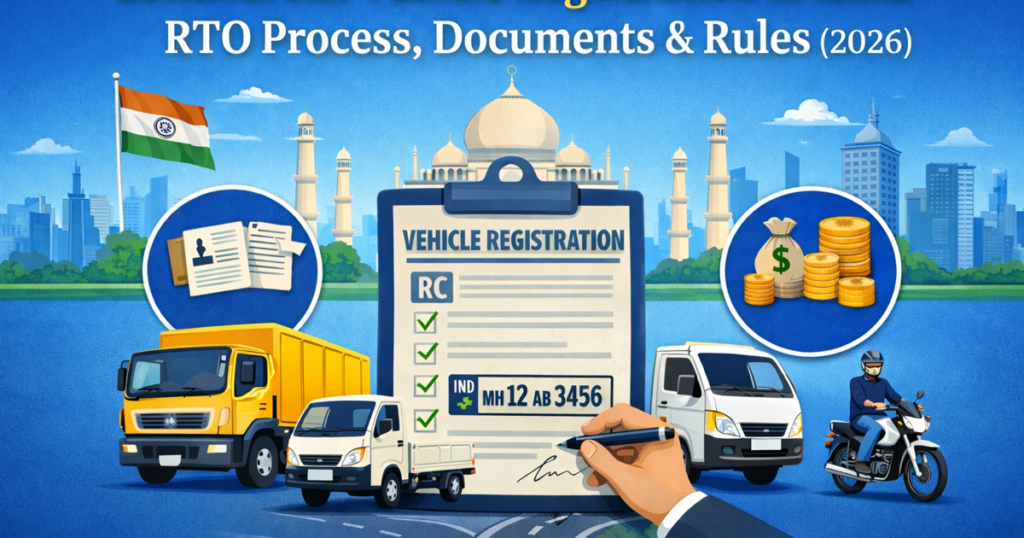
Car Registration Process in India 2026 – Bought a new car? The registration process in 2026 is mostly digital now. Dealers handle most of it, and you probably won’t need to step inside an RTO office at all.
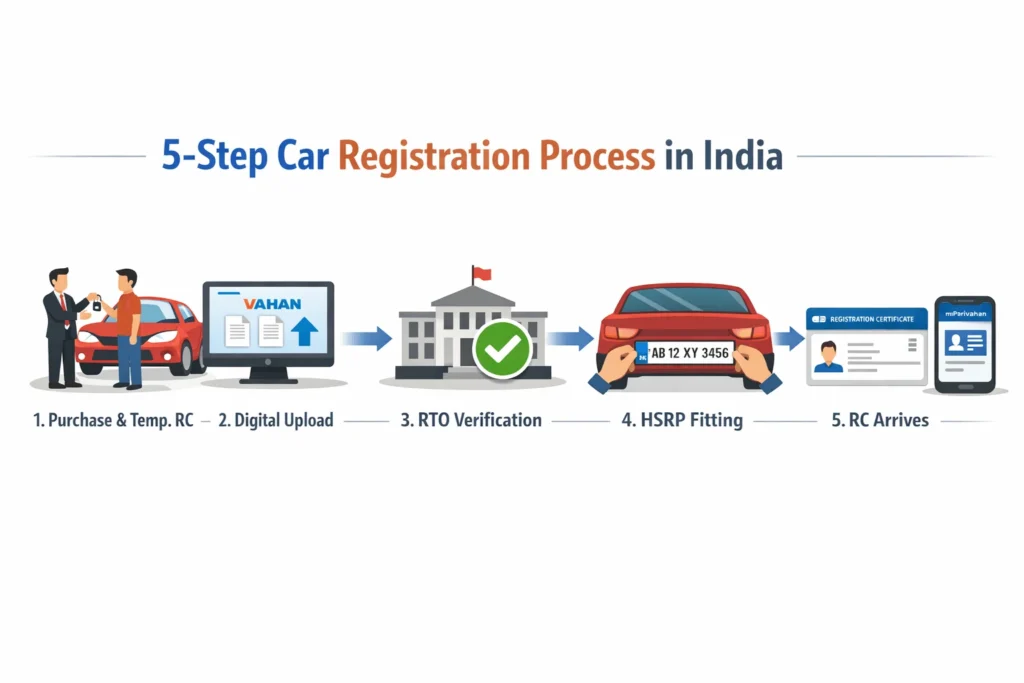
Here’s how it works, start to finish:
- Buy the car and get temporary registration from the dealer (valid 30 days)
- Dealer uploads Form 20 and all documents digitally to the Vahan portal
- RTO verifies documents and assigns a permanent registration number within 2 working days
- HSRP plates get fitted at the dealership itself
- Your RC Smart Card arrives by post in 45-60 days, but the Virtual RC on the mParivahan app is legally valid from day one
That’s the quick version. Below is everything you actually need to know, whether the dealer is doing the legwork or you’re handling it yourself.
Car Registration Process in India 2026 – Navigating the car registration process in India has become significantly more streamlined in 2026, thanks to the digital-first approach of the Vahan 4.0 portal. Whether you are buying a standard petrol SUV or a new-age Electric Vehicle (EV), understanding the paperwork, the BH-Series option, and the new Scrappage Policy incentives is key to a smooth experience.
Documents Required for Car Registration
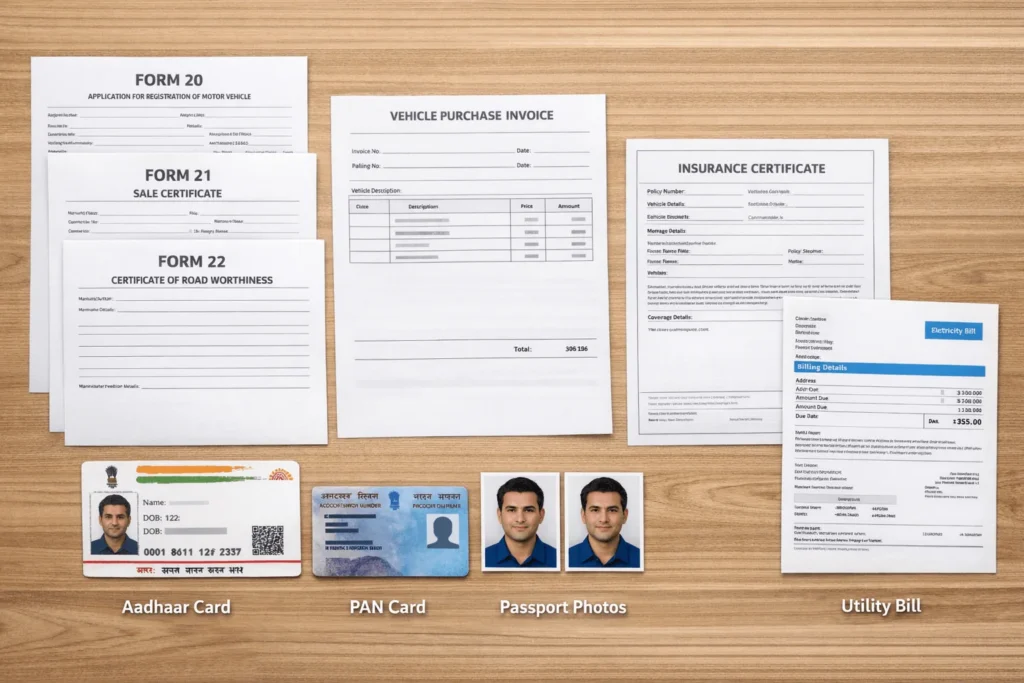
You’ll need two sets of documents. Most come from the dealer. You only need to arrange a few from your end.
What the Dealer Provides
| Document | What It Is |
|---|---|
| Form 21 (Sale Certificate) | Issued by the dealer or manufacturer. Contains vehicle model, manufacturing date, invoice amount |
| Form 22 (Road Worthiness Certificate) | Issued by the manufacturer. Confirms the vehicle meets safety and emission standards |
| Invoice | Purchase invoice with ex-showroom price, GST breakup, chassis number, engine number |
| Temporary Registration | The TR number assigned at delivery. Valid for 30 days |
| Insurance Certificate | Must be valid for at least one year. Engine and chassis numbers should match the invoice |
What You Need to Arrange
| Document | Notes |
|---|---|
| Form 20 (Registration Application) | The main application form. Dealer fills it, you sign. Uploaded digitally to Vahan in 2026 |
| Aadhaar Card | Primary ID and address proof in most states |
| PAN Card | Mandatory for transactions above ₹50,000 |
| Passport-size photos | 2-4 copies depending on the state |
| Address proof | Aadhaar usually works. If registering at a different address, carry a utility bill or bank statement |
The Step-by-Step Workflow (2026)
Step 1: Dealer Uploads Data
Car Registration Process in India 2026 – Most of the process is now handled by the dealer via the Vahan Portal. They upload your documents and the vehicle’s chassis/engine details digitally.
Step 2: Payment of Fees and Road Tax
You (or the dealer) must pay the Registration Fee (approx. ₹600) and the Road Tax.
Note: Road tax varies by state. In 2026, many states offer a 100% waiver on road tax for Electric Vehicles to promote green mobility.
Step 3: Vehicle Inspection
For most mass-market cars, physical inspection at the RTO is waived if the dealer is “Self-Registering” authorized. However, for imported (CBUs) or modified vehicles, a physical visit to the RTO is mandatory for an inspector to verify the chassis number.
Step 4: Number Generation
Once the RTO superintendent approves the digital file, a registration number is generated. You will receive an SMS with your new vehicle number.
Step 5: HSRP (High-Security Registration Plate) Affixation
In 2026, it is illegal to drive without HSRP. The plates are ordered through the portal and delivered to your dealership. You must take your car to the dealer to get these plates laser-coded and riveted to your car.
5. Incentives via the Scrappage Policy
If you are replacing a vehicle older than 15–20 years, you can save a fortune in 2026.
- Registration Fee Waiver: Presenting a Certificate of Deposit (from scrapping your old car) waives the registration fee for the new car.
- Road Tax Rebate: Many states offer up to a 25% concession on road tax for new cars bought against a scrapped old vehicle.
- Manufacturer Discount: Most OEMs offer an additional 5% discount on the ex-showroom price if you provide the scrappage certificate.
6. Estimated Costs & Slabs (Standard Registration)
While costs fluctuate, here is a general guideline for registration charges in 2026:
| Vehicle Price (Ex-Showroom) | Road Tax % (Petrol) | Road Tax % (Diesel) |
| Up to ₹10 Lakh | 7% – 9% | 9% – 11% |
| ₹10 Lakh – ₹20 Lakh | 10% – 12% | 12% – 14% |
| Above ₹20 Lakh | 12% – 15% | 14% – 18% |
Secondary costs include: Hypothecation fee (₹1,500 if on loan), Smart Card fee (₹200), and FastTag (₹500).
Self-Registration at the RTO
Want to save on the dealer’s handling fee? Or buying in one city and registering in another? Self-registration still works.
Step 1: Collect all documents from the dealer before taking delivery. Form 21, Form 22, invoice, insurance copy, temporary registration slip. Don’t drive off without these.
Step 2: Visit your jurisdictional RTO with the vehicle. Drive the car to the RTO that covers your residential address.
Step 3: Fill and submit Form 20 with all supporting documents at the registration counter.
Step 4: Pay the registration fee and road tax at the cash counter.
Step 5: Vehicle inspection. An Inspector of Motor Vehicles physically examines the car. They verify the chassis number and engine number against your documents. Everything has to match.
Step 6: Registration number assigned. After verification, the RTO assigns your permanent number. The RC Smart Card follows by post.
Tip for self-registration: Go early on a weekday. RTOs get extremely crowded toward month-end. Carry originals plus two sets of photocopies. Some RTOs still ask for physical copies despite the digital push.
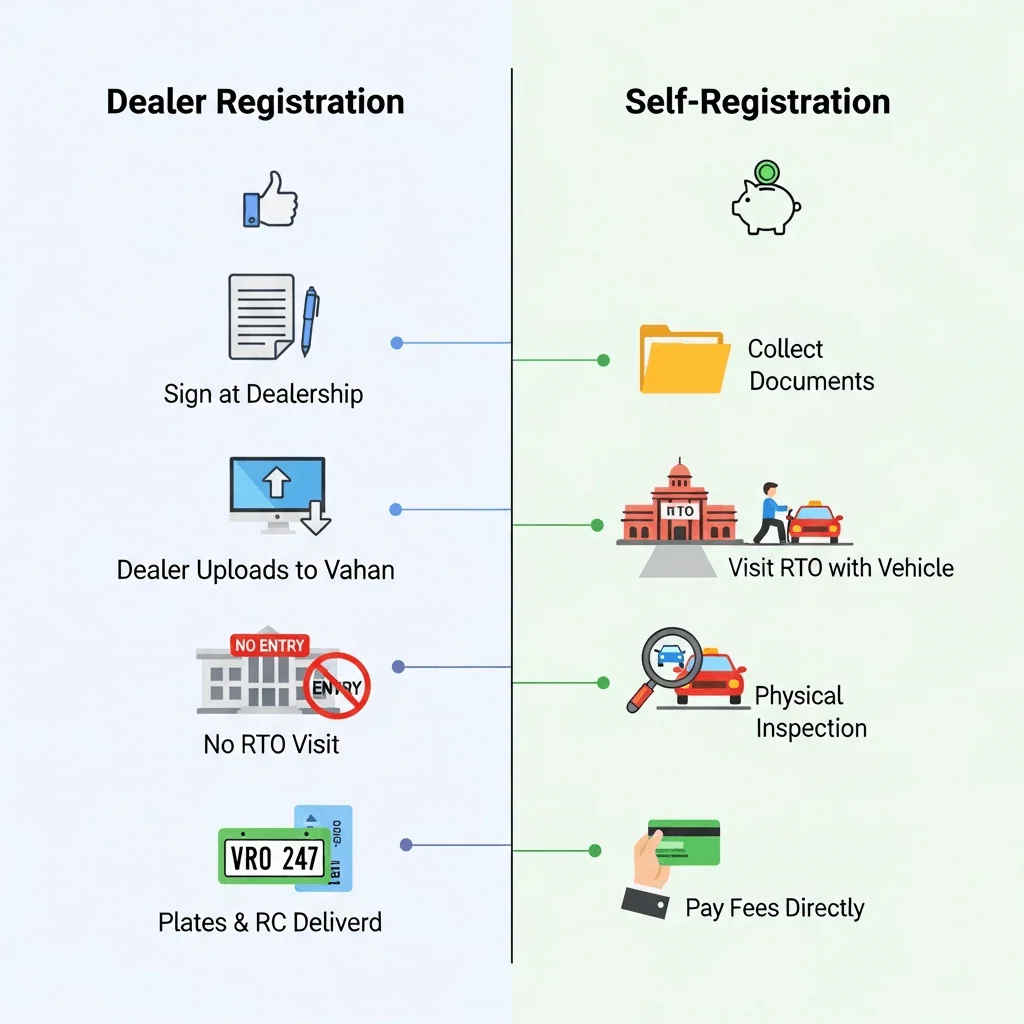
Dealer vs Self-Registration: Quick Comparison
| Factor | Dealer-Handled | Self-Registration |
|---|---|---|
| Convenience | High. Sign and wait | Low. Multiple RTO visits possible |
| Cost | RTO fees + dealer service charge (₹2,000-₹5,000 extra) | Only actual RTO fees |
| Time | 2-7 working days | Can take longer depending on RTO queue |
| RTO visit needed? | No | Yes, mandatory |
| Best for | Same-city registration | Inter-state purchases, saving money |
Registration Fees and Road Tax Overview
Car Registration Process in India 2026 – Two components. Fixed RTO fees (same everywhere) and road tax (varies wildly by state). Guess which one stings more?
Fixed RTO Charges
| Fee Component | Amount |
|---|---|
| Registration fee | ₹600 |
| HSRP (number plate) | ₹230-₹400 |
| Hypothecation charge (if financed) | ₹1,500 |
| FASTag | ₹500-₹600 |
| RC Smart Card | ₹200 |
| Temporary registration | ₹150-₹200 |
Paying cash? Fixed fees add up to roughly ₹1,700-₹2,000. Taken a loan? Add the hypothecation charge, bringing it to roughly ₹3,200-₹3,500 total. Not bad.
Summary Checklist for a Hassle-Free Process
- Verify Aadhaar: Ensure your mobile number is updated for OTP-based e-KYC.
- Check BH-Eligibility: If you move states often, apply for BH-Series during the initial booking.
- Scrappage Certificate: If you have an old “junk” car, scrap it before buying the new one to claim the 25% road tax rebate.
- Download mParivahan: Once registered, your Digital RC is legally valid on the mParivahan app.
Car registration in India has moved from “queues and clerks” to “clicks and codes.” By staying informed about the latest 2026 norms, you not only save time but can also avail of significant financial benefits offered by the government’s green initiatives.
Are you considering a specific state for registration, or would you like to know more about the eligibility criteria for the BH-series?